When 1941: Counter Attack reached arcades in 1990, Capcom was returning to one of the series that had helped define its early reputation. 1942 had sent players across the Pacific in 1984, while 1943: The Battle of Midway expanded the formula three years later with larger enemies, weapon upgrades, and a more elaborate health system. For the next numbered entry, however, Capcom did something unexpected. Instead of moving the calendar forward, it went backward to 1941, moved the fighting from the Pacific toward Europe, and built a far more elaborate vertical shooter around its increasingly powerful CP System hardware.
The result was a game that looked familiar from a distance but felt considerably different in motion. Cities, cliffs, battleships, fortifications, enormous aircraft, and increasingly fantastic machines filled its six stages. A charged weapon system encouraged players to do more than simply hold down the fire button, while a vitality meter and destructive special attacks created a constant tradeoff between survival and overwhelming force. Modern retrospectives sometimes overlook 1941 between the better known 1943 and 19XX: The War Against Destiny, but contemporary records show that the game made an immediate impression in Japanese arcades and later gained a second life through an unusually faithful SuperGrafx conversion.
Capcom Returns to the 194X Series
By 1990, Capcom was no longer the relatively young arcade developer that had released 1942. The company had spent the second half of the 1980s producing games such as Ghosts ‘n Goblins, Gun.Smoke, Commando, Side Arms, and 1943, while developing a recognizable approach to arcade action built around vivid graphics, memorization, aggressive enemy patterns, and increasingly sophisticated hardware.
The introduction of the CP System, usually known today as CPS-1, gave Capcom considerably more room to experiment. Company president Kenzo Tsujimoto explained in a period interview that increased memory was one of the board’s central advantages because it allowed developers greater freedom to pursue ideas that older hardware could not handle as easily. Copy protection was another major concern, particularly because Capcom was dealing with unauthorized boards in overseas markets.
That additional power mattered for 1941. Earlier games in the series often placed the player’s fighter above relatively repetitive expanses of ocean, but 1941 could surround the aircraft with much more elaborate scenery. The player flies above or through coastlines, ruined urban areas, narrow spaces, industrial installations, military defenses, and other environments that increasingly become part of the action rather than merely serving as a background. Hardcore Gaming 101 later described the change as one of the game’s major advances over its predecessors, particularly because the scenery gave individual stages more distinct identities.
The Mystery of Capcom’s Eighth CP System Game
Even something as straightforward as 1941’s place in Capcom’s hardware chronology becomes interesting when contemporary evidence is compared with later databases.
Modern arcade references commonly identify 1941 as CP-S No. 07 or describe it as the seventh CPS release. Arcade-History, for example, places the game on Capcom’s CP System hardware and describes it as the seventh CP-S title.
Capcom itself apparently counted differently in 1990. A contemporary advertisement reproduced in the February 15 issue of Game Machine labels 1941 as “CP System 第8弾,” identifying it as the eighth CP System release in Capcom’s own marketing. The same issue also contains coverage from the 1990 Amusement Trades Exhibition International in Britain, where 1941 was displayed beside the relatively new Final Fight.
The surviving research material for the game includes an even earlier January 1990 Capcom advertisement using the same eighth-release designation.
For a history of the game, Capcom’s contemporary designation deserves particular weight. Later technical numbering may have been based on board identification, internal sequencing, or a different definition of what constituted a release, while the advertisements tell us how Capcom itself presented 1941 to arcade operators at the time. Rather than quietly choosing one number, the disagreement is worth preserving because it demonstrates how even relatively recent video game history can become complicated once original advertising and later databases are compared.
Fighting a Different Kind of War
The basic structure remained recognizable to anyone who had played 1942 or 1943. 1941 is a vertically scrolling shooter supporting one or two players. Player One flies a P-38 Lightning, while Player Two controls a Mosquito B Mk. IV. An eight-way joystick moves the aircraft, with two buttons handling weapons and special actions.
What Capcom built around those controls was more ambitious. The player’s fighter uses a vitality meter instead of simply exploding after every hit. Weapons can be strengthened through power-ups, and holding the attack button charges a more powerful shot. Options or accompanying aircraft can supplement the main fighter, while another power-up produces trailing images that follow the aircraft through the stage. Colliding with certain walls or pieces of scenery does not necessarily destroy the player. Instead, the aircraft can spin, temporarily altering the direction of its fire and creating situations in which the environment itself becomes part of the player’s movement strategy.
The special attack creates one of the game’s more interesting decisions. Using it can clear dangerous situations, but doing so consumes vitality, the same resource that protects the aircraft from enemy fire. A player who relies on special attacks too heavily can therefore leave little room for mistakes later in a stage.
Capcom also added a charged shot, a mechanic that would continue to appear in later entries in the series. Instead of continuously firing at everything on screen, experienced players could learn when to hold their fire, build energy, and release a more destructive attack against tougher formations or bosses. These changes make 1941 feel more deliberate than the earliest 194X games without sacrificing the relentless pace expected from an arcade shooter.
A World War II Game That Quickly Leaves History Behind
The title places the game firmly in 1941, but 1941: Counter Attack should not be mistaken for an attempt at historical simulation. Capcom borrowed real aircraft, naval imagery, European locations, and recognizable pieces of wartime technology, then freely mixed them with machines that belonged to later years or never existed in the forms shown on screen.
The battleship Bismarck appears among the named bosses, which at least fits the chosen year. The real Bismarck’s brief operational career ended in May 1941. Other enemies push far beyond that historical boundary. One boss is identified as the V3Rocket, although the historical V-3 was not a rocket at all. It was a German long-range supergun project associated with a later period of the war. Even arcade preservation databases explicitly note this historical problem.
The game’s later machinery becomes even more fantastical. The final boss is called Gotha and resembles the kind of flying-wing technology Germany pursued much later in the conflict. The actual Horten Ho 229 project did not reach the powered prototype stage until near the end of the war. The Smithsonian’s National Air and Space Museum dates the project’s serious development to 1943 and notes that a jet-powered prototype first flew in 1945.
That disconnect is part of 1941’s identity rather than simply a collection of errors. The game begins with enough recognizable Second World War imagery to establish its setting, then steadily turns the conflict into Capcom’s own mechanical fantasy. Historical aircraft fly beside imaginary superweapons, ordinary military installations give way to enormous machines, and the scale of the conflict expands until the player is fighting technology that belongs closer to alternate history than to 1941.
The Developers Behind the Counter Attack
The credits place 1941 inside an especially important period in Capcom’s history. Yoshiki Okamoto served as director, while the development staff included figures such as Noritaka Funamizu and Akira Yasuda, later widely known as Akiman. Hiromitsu Takaoka handled the game’s music. Surviving credit records also preserve numerous developer nicknames and aliases, a common feature of Japanese game credits from the period.
A 1991 interview with Okamoto, Funamizu, and Akira Nishitani provides unusually valuable context because it captures these developers discussing their work when the games were still recent. Funamizu recalled that although his principal planning work included the Tenchi wo Kurau games, he also assisted with projects including Area 88, 1941, and Chiki Chiki Boys. Okamoto described Funamizu as someone particularly skilled at entering projects late in development and refining them.
The same interview shows how deeply shooting games remained embedded in Capcom’s design culture. Okamoto discussed his affection for titles such as Xevious and specifically praised 1943 Kai for its balance, while Funamizu described himself as a fan of Konami’s Gradius. Those influences help place 1941 within a generation of Japanese designers who were not merely producing shooters because they sold well. They were themselves enthusiasts of the genre, constantly studying how enemy patterns, weapon systems, difficulty, and memorization could be refined.
An Immediate Arcade Success in Japan
Contemporary arcade trade records provide something particularly valuable for 1941: evidence of how the game actually performed when it was new.
In the March 15, 1990 issue of Game Machine, 1941 debuted at number three on the magazine’s table video game chart with a rating of 7.88. Only Capcom’s own Final Fight and Data East’s Vapor Trail ranked ahead of it. Sega’s Tetris sat immediately below it. That is strong evidence that 1941 was not an obscure release that only developed a reputation years later. It was competing near the top of one of Japan’s most important arcade trade charts almost immediately.
Its position declined as newer machines entered the market, which was normal in the rapidly changing arcade business. By April 15 it had fallen to eleventh with a 6.70 rating, and by May it appeared at fifteenth.
The annual figures provide a better measure of its overall staying power. When Game Machine assembled its 1990 results, 1941 finished twentieth in the magazine’s Best Software 25 with an evaluation score of 1,494. That placed it in a year dominated by enormous arcade releases including Tetris, Final Fight, Columns, Parodius, Gradius III, and several major sports and quiz games.
It may never have achieved the cultural visibility of Final Fight, but the period evidence shows a commercially relevant shooter arriving during an unusually competitive moment in Japanese arcade history.
From Japan to European Arcades
1941 was also circulating internationally very early in its life. The February 1990 ATEI report in Game Machine noted Capcom displaying Final Fight and 1941, placing the shooter before European arcade buyers at one of the industry’s major trade events.
British and continental European magazines soon followed. Zzap!64 covered the arcade release through Electrocoin in March 1990, while Germany’s Power Play reviewed it that summer. Japanese magazines such as Beep! Mega Drive had already discussed the arcade game almost immediately after its debut. Together, these magazines provide a wider picture of a game that was being evaluated simultaneously in Japan and Europe rather than remaining confined to Capcom’s home market.
Preserved ROM information also demonstrates that Capcom produced distinct Japanese and export sets. The Japanese B-board is commonly cataloged as 89625B-1, while a known export board carries the designation 89624B-3. Preservation records identify USA and ETC versions dated 900227, showing how technical preservation can supplement magazine evidence when reconstructing the international history of an arcade release.
Hudson Soft Brings 1941 Home
For an arcade game with such strong initial visibility, 1941 had a surprisingly limited early home-console history. Instead of receiving conversions for the numerous mainstream machines of the period, its major contemporary home version appeared on NEC’s SuperGrafx, an enhanced member of the PC Engine family that ultimately accumulated a very small software library.
Hudson Soft handled the conversion, releasing it in Japan on August 23, 1991.
That unusual platform choice eventually helped turn the SuperGrafx edition into a particularly interesting artifact. The system never built a large installed base or library, yet Hudson produced a conversion that remained remarkably close to Capcom’s arcade original. The narrower display changed the amount of visible play space, and some graphical differences were unavoidable, but comparisons of the two versions have repeatedly praised the conversion’s fidelity.
Contemporary reviewers noticed. The surviving research record shows substantial Japanese coverage in Famitsu, Gekkan PC Engine, Marukatsu PC Engine, and Hippon Super!, followed by French reviews in publications including Consoles +, Joypad, Joystick, Player One, and Génération 4. Consoles + awarded the conversion 83 percent, while modern archival listings record similarly positive period responses elsewhere.
For years, that SuperGrafx cartridge represented the closest thing to a dedicated home version of 1941, making it an unusually important port for a console that otherwise occupies a small corner of video game history.
The One Point That Told Everyone You Continued
One of 1941’s strangest historical footnotes has nothing to do with aircraft or hardware.
The game is widely credited with helping popularize a scoring convention in which continuing adds a single point to the player’s score. Because ordinary scoring occurs largely in larger increments, the final digit can reveal that the player inserted another credit rather than completing the run on the original attempt. Arcade databases identify 1941 as the first shooter to use the system in this fashion, while later histories have described it as a quiet mark showing how many continues had been used.
It is a tiny design choice, but one perfectly suited to the competitive culture of arcades. A displayed score could no longer tell only how many targets a player destroyed. Its final digit could also preserve evidence of whether that accomplishment required another coin.
Sound, Style, and Capcom’s Growing Arcade Identity
The game’s presentation also captures Capcom at a moment when arcade soundtracks were becoming increasingly important outside the machines themselves. Hiromitsu Takaoka’s music accompanied stages with faster, more energetic compositions than much of the earlier series, while the CP System gave the audio more presence than Capcom’s older boards.
The soundtrack did not remain trapped inside the cabinet. Music from 1941 appeared on Final Fight: G.S.M. Capcom 3, released by Pony Canyon and Scitron on May 21, 1990. The album connected 1941 to the growing Japanese market for commercial video game music and preserved its soundtrack only months after the arcade release.
It was another sign of the changing status of arcade games. Graphics, characters, packaging art, music, and developer identities were becoming pieces of a larger popular culture rather than disposable components of machines expected to disappear when the next title arrived.
Preservation and a Much Longer Life
For many years, experiencing 1941 outside an arcade or original SuperGrafx required access to increasingly specialized hardware. That gradually changed as Capcom began treating its arcade catalog as a historical library.
The game appeared in later Capcom compilations, including Capcom Classics Collection Remixed for PSP and Capcom Classics Collection Vol. 2 for PlayStation 2 and Xbox. Preservation projects also documented the Japanese, American, and world ROM revisions in increasing technical detail.
A much more accessible return came through Capcom Arcade Stadium. Nintendo’s official listing identifies 1941: Counter Attack as a one-to-two-player cooperative shooter published by Capcom, with Japanese and English versions available through the collection. The Switch edition was released on February 17, 2021.
Modern availability has allowed a game once tied to expensive arcade boards and one of NEC’s rarest console platforms to become accessible again without stripping away its original structure. For historians, preservationists, and players interested in Capcom before Street Fighter II reshaped the company, 1941 offers a particularly useful snapshot.
Why 1941: Counter Attack Matters
1941: Counter Attack occupies an unusual position in Capcom’s history. It belonged to an established series but was willing to abandon much of that series’ visual formula. It borrowed the Second World War while showing little concern for remaining inside the technological boundaries of 1941. It appeared on the CP System while Capcom was rapidly becoming one of the world’s most important arcade developers, then received its principal contemporary home conversion on a console that would become famous precisely because so few games were released for it.
Its historical record is unusually rich. Original Capcom advertising tells us how the company marketed the game. Game Machine charts demonstrate that players were interested when it appeared. Contemporary Japanese, British, German, and French magazines show how rapidly it traveled through the international arcade press. A 1991 developer interview connects it to the people working inside Capcom, while surviving arcade boards, ROM sets, flyers, soundtrack releases, and SuperGrafx materials preserve pieces of the game that magazine reviews alone cannot capture.
Most importantly, it represents a point when Capcom’s shooters were becoming more visually ambitious without abandoning the demanding design principles that had defined the company’s earlier arcade work. The six stages are short enough to invite another attempt, difficult enough to reward memorization, and varied enough that each feels like part of a journey rather than another stretch of scrolling ocean.
The number on the title screen says 1941, but the game itself belongs unmistakably to 1990. It reflects a moment when more powerful arcade hardware, experienced designers, expanding international distribution, and a fiercely competitive Japanese arcade market were pushing the shoot ’em up forward. Between the historical aircraft, impossible superweapons, ruined cities, enormous bosses, and one accusing digit added to the player’s score after a continue, 1941: Counter Attack became something more memorable than a simple sequel. It became Capcom’s alternate version of the Second World War, built one quarter at a time.
Sources & Further Reading
Capcom. “1941: Counter Attack.” Advertisement. Game Machine, no. 371, January 1, 1990. https://onitama.tv/gamemachine/pdf/19900101p.pdf.
Capcom. “1941: Counter Attack.” Advertisement. Game Machine, no. 374, February 15, 1990. https://onitama.tv/gamemachine/pdf/19900215p.pdf. Capcom’s contemporary advertising identifies the game as the eighth CP System release. オニオン製作所
Game Machine. No. 374. February 15, 1990. Contemporary amusement-industry coverage of the ATEI exhibition and Capcom’s 1941: Counter Attack. https://onitama.tv/gamemachine/pdf/19900215p.pdf.
Game Machine. No. 375. March 1, 1990. Contemporary Japanese arcade trade coverage of 1941: Counter Attack. https://onitama.tv/gamemachine/pdf/19900301p.pdf.
Game Machine. “Game Machine’s Best Hit Games 25.” No. 376. March 15, 1990. https://onitama.tv/gamemachine/pdf/19900315p.pdf.
Game Machine. “Game Machine’s Best Hit Games 25.” No. 378. April 15, 1990. https://onitama.tv/gamemachine/pdf/19900415p.pdf.
Game Machine. “Videos of the Year 1990.” No. 396. February 1, 1991. https://onitama.tv/gamemachine/pdf/19910201p.pdf.
Hogg, Robin. “Arcades: Electrocoin.” Zzap!64, no. 59, March 1990, 40. https://archive.org/stream/zzap64-magazine-059#page/n39/mode/1up.
“極楽VGブラザーズ: 1941 (カプコン).” Beep! Mega Drive, no. 6, March 1990, 97. https://retrocdn.net/index.php?title=File:BeepMD_JP_1990-03.pdf&page=99.
Locker, Anatol, and Martin Gaksch. “Power Tests Automatenspiele: Fang’ den Hut.” Power Play, no. 28, July 1990, 133. https://www.kultboy.com/index.php?site=t&id=13428&s=2.
Capcom. 1941: Counter Attack Sales Flyer. International Arcade Museum, Arcade Flyer Archive. https://flyers.arcade-museum.com/videogames/show/5408.
Capcom. Capcom Concept Cabinet Sales Flyer. 1991. International Arcade Museum, Arcade Flyer Archive. https://flyers.arcade-museum.com/videogames/show/3927.
Capcom. 1941: Counter Attack. Arcade operator and service documentation. Preserved through Arcade-History. https://www.arcade-history.com/?id=5&n=1941-counter-attack-b-board-89625b-1&o=7&page=detail.
Capcom. 1941: Counter Attack. Arcade game. 1990. Staff credits transcribed by MobyGames. https://www.mobygames.com/game/34268/1941-counter-attack/.
Capcom and Hudson Soft. 1941: Counter Attack. SuperGrafx edition. 1991. Packaging and related materials preserved by the PC Engine Software Bible. https://pcengine.co.uk/HTML_Games/1941.htm.
“NEW GAMES CROSS REVIEW: 1941.” Famitsu, no. 141, September 6, 1991, 37. https://archive.org/details/famitsu0142/page/37/mode/1up.
“発売直前 REVIEW: 1941 (SG).” Gekkan PC Engine 3, no. 9, September 1991, 147. https://archive.org/details/gekkan-pc-engine-issue-36-september-1991/Gekkan%20PC%20Engine%20-%20Issue%2036%20-%20September%201991/page/147/mode/1up.
“新作ソフトお毒味チャート: 1941 (SG).” Marukatsu PC Engine 3, no. 9, September 1991, 119. https://archive.org/details/marukatsu-pc-engine-volume-33-september-1991/Marukatsu%20PC%20Engine%20-%20Volume%2033%20-%20September%201991/page/119/mode/1up.
Kitamakura, Take. “TV Game Broad-Way PC: 1941 (SG専用).” Hippon Super! 6, no. 9, September 4, 1991, 84. https://archive.org/details/hippon-super-september-1991-09-600dpi-ozidual/Hippon%20Super%201991%2009%20%28J%20OCR%29/page/n85/mode/1up.
Loulou, and Wilkie. “Supergrafx Review: 1941: Counter Attack.” Consoles +, no. 2, October 1991, 36–38. https://archive.org/stream/Console_Plus_Numero_002#page/36/mode/2up.
Huyghues-Lacour, Alain, and Jean-Marc Demoly. “NEC | Tests: 1941.” Joypad, no. 1, October 1991, 88–89. https://www.abandonware-magazines.org/affiche_mag.php?mag=84&num=1770&album=oui.
Demoly, Jean-François. “Consoles News: Supergrafx: 1941.” Joystick, no. 20, October 1991, 155. http://download.abandonware.org/magazines/Joystick/joystick_numero020/page%20155.jpg.

Scamps, Olivier. “Tests De Jeux: Super G.: 1941: Counter Attack.” Player One, no. 13, October 1991, 75. http://download.abandonware.org/magazines/Player%20One/playerone_numero013/Player%20One%20013%20-%20Page%20075%20%281991-10%29.jpg.
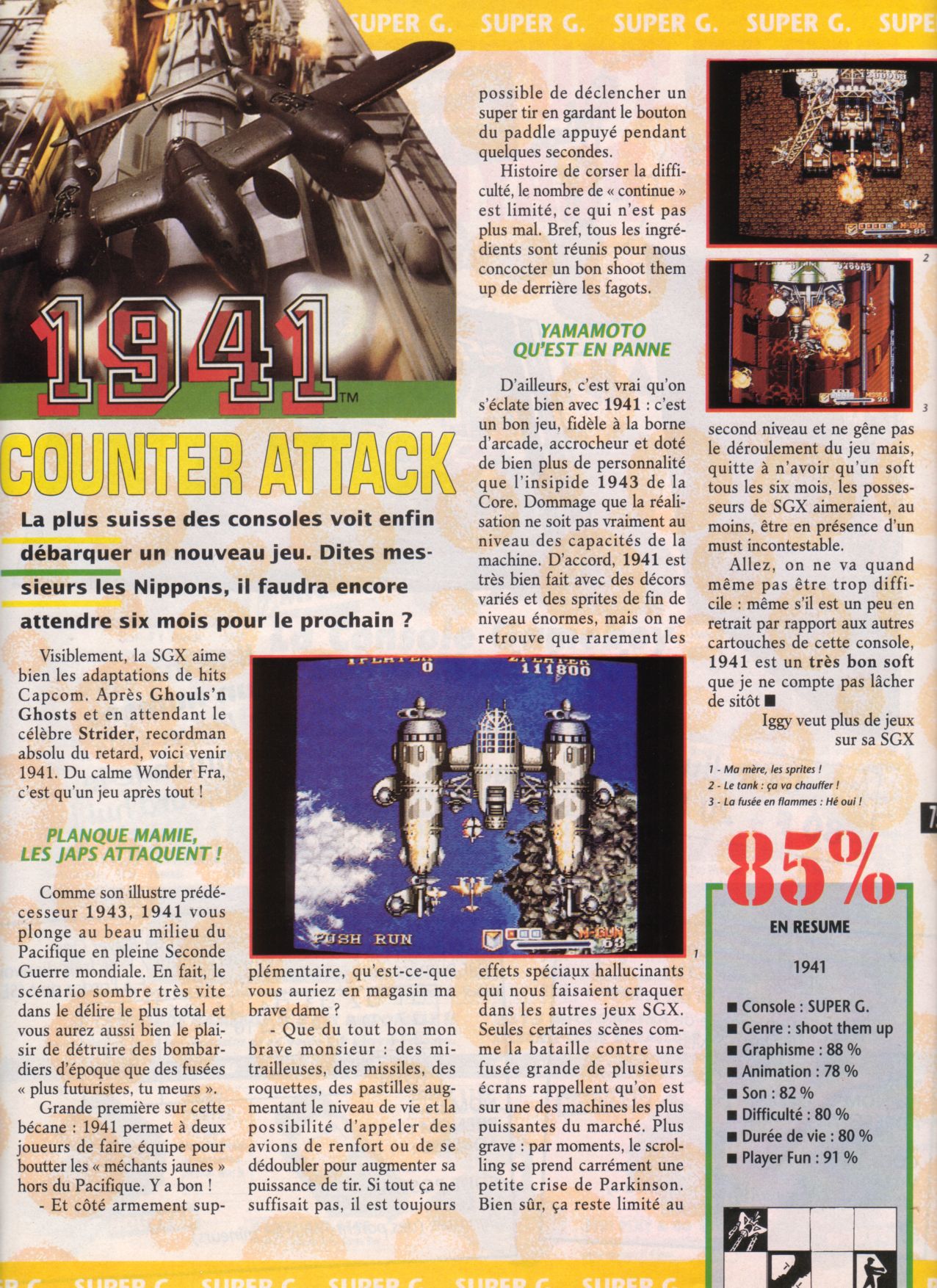
Ladoire, Frank. “Console Test: 1941: Supergrafx.” Génération 4, no. 37, October 1991, 154–55. http://download.abandonware.org/magazines/Generation%204/generation4_numero037/generation%204%20-%20N037%20-%20octobre%201991%20-%20page154%20et%20page155.jpg.
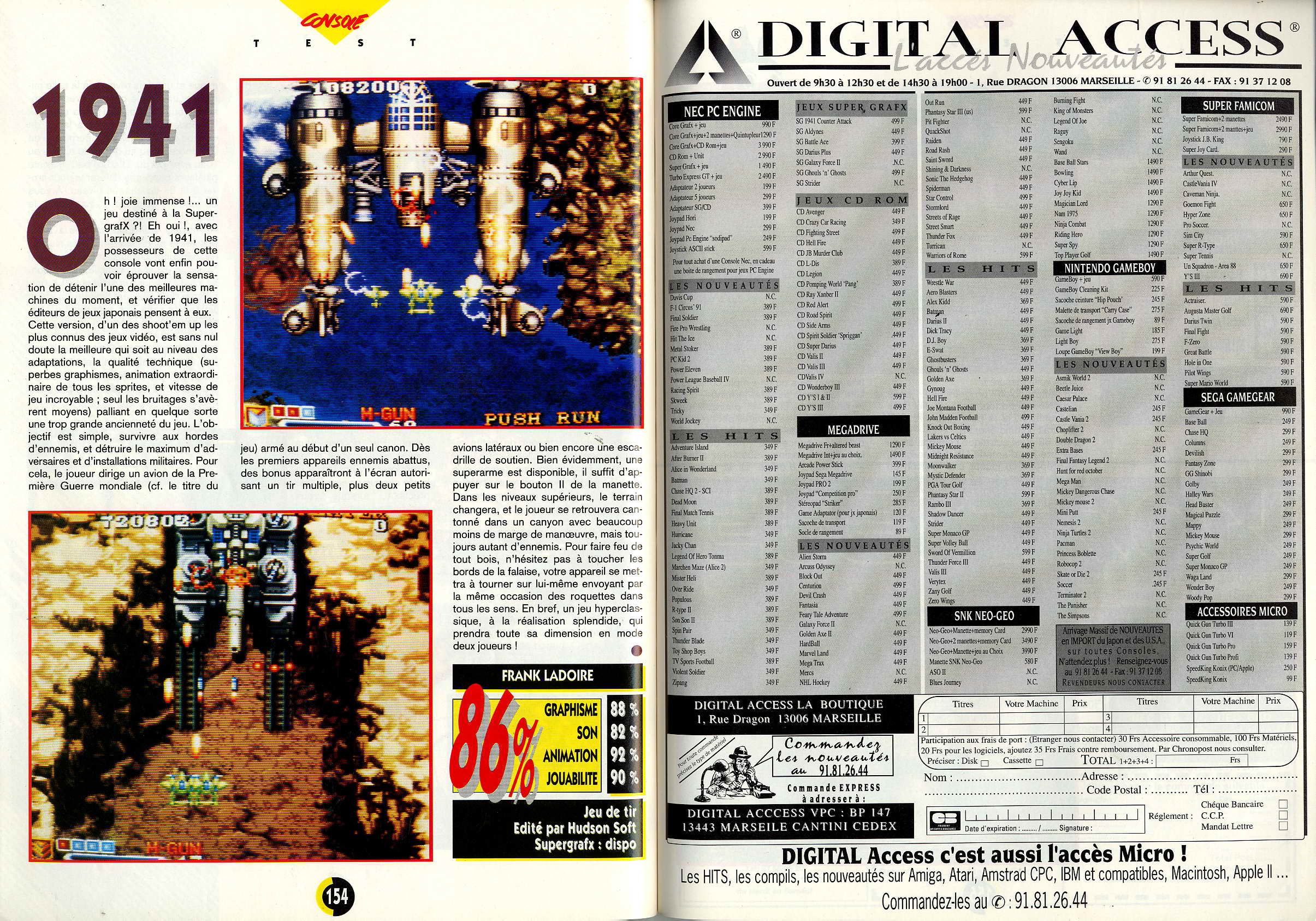
PC Engine Fan. “PC Engine All Catalog ’93.” October 1, 1993, 70.
Gamest Mook. The Best Game 2: 26 Years of Arcade Video Game History. 1998, 18–19. https://archive.org/stream/vol.-112-2#page/n19/mode/2up.
Okamoto, Yoshiki, Noritaka Funamizu, and Akira Nishitani. “Capcom 1991 Retrospective Interview.” Translated by Shmuplations. https://shmuplations.com/capcom1991/.
“Capcom and the CPS-1: Developer Interviews.” Shmuplations. Translations of interviews with Capcom developers and executives from 1989 and 1991. https://shmuplations.com/cps1/.
Akagi, Masumi. Arcade TV Game List: Domestic and Overseas Edition (1971–2005). Japan: Amusement News Agency, 2006. https://archive.org/details/ArcadeGameList1971-2005.
Arcade-History. “1941: Counter Attack [B-Board 89625B-1].” Accessed October 11, 2026. https://www.arcade-history.com/game/5/1941-counter-attack.
Arcade-History. “1941: Counter Attack [B-Board 89624B-3].” Accessed October 11, 2026. https://www.arcade-history.com/game/69748/1941-counter-attack-b-board-89624b-3.
International Arcade Museum. “1941: Counter Attack (Japan).” Museum of the Game. Accessed October 11, 2026. https://www.arcade-museum.com/tech-center/machine/1941j.
International Arcade Museum. “1941: Counter Attack (USA 900227).” Museum of the Game. Accessed October 11, 2026. https://www.arcade-museum.com/tech-center/machine/1941u.
International Arcade Museum. “1941: Counter Attack (World).” Museum of the Game. Accessed October 11, 2026. https://www.arcade-museum.com/tech-center/machine/1941r1.
MobyGames. “1941: Counter Attack.” Accessed October 11, 2026. https://www.mobygames.com/game/34268/1941-counter-attack/.
MobyGames. “1941: Counter Attack: Releases.” Accessed October 11, 2026. https://www.mobygames.com/game/34268/1941-counter-attack/releases/.
Zverloff, Nick. “1941: Counter Attack.” Hardcore Gaming 101. August 17, 2011. https://www.hardcoregaming101.net/1941-counter-attack/.
Arcade Italia. “1941: Counter Attack.” Arcade Database. Accessed October 11, 2026. https://adb.arcadeitalia.net/dettaglio_mame.php?game_name=1941j&lang=en&search_id=1.
VGMdb. “1941: Counter Attack.” SuperGrafx release information and music credits. Accessed October 11, 2026. https://vgmdb.net/release/34311.
Pony Canyon and Scitron. Final Fight: G.S.M. Capcom 3. PCCB-00030. May 21, 1990. Soundtrack album containing music from 1941: Counter Attack. https://www.arcade-history.com/game/5/1941-counter-attack-b-board-89625b-1.
Capcom. “Capcom Arcade Stadium Is Available Now.” Capcom News. https://news.capcomusa.com/lets/browse/capcom-arcade-stadium-is-available-now-for-playstation-4-xbox-one-nintendo-switch-and-steam.
Capcom. “Capcom Arcade Stadium: 1941: Counter Attack.” Steam. Accessed October 11, 2026. https://store.steampowered.com/app/1556713/Capcom_Arcade_Stadium1941__Counter_Attack/.
Nintendo. “Capcom Arcade Stadium: 1941: Counter Attack.” Accessed October 11, 2026. https://www.nintendo.com/us/store/products/capcom-arcade-stadium1941-counter-attack-70050000025474-switch/.
PC Engine Software Bible. “1941: Counter Attack.” Accessed October 11, 2026. https://pcengine.co.uk/HTML_Games/1941.htm.
Games Database. “1941: Counter Attack.” NEC SuperGrafx. Accessed October 11, 2026. https://www.gamesdatabase.org/game/nec-supergrafx/1941-counter-attack.aspx/.
Smithsonian National Air and Space Museum. “Horten Ho 229 V3.” Smithsonian Institution. Accessed October 11, 2026. https://www.si.edu/object/nasm_A19600324000.