In 1993, the video game industry was crowded with would-be mascots. Mario and Sonic had already demonstrated the value of a recognizable character, and publishers spent much of the early 1990s searching for heroes who might become the face of their next platform game. Into that crowded field walked, jumped, flew, and occasionally dive-bombed a bright red bird named Alfred Chicken.
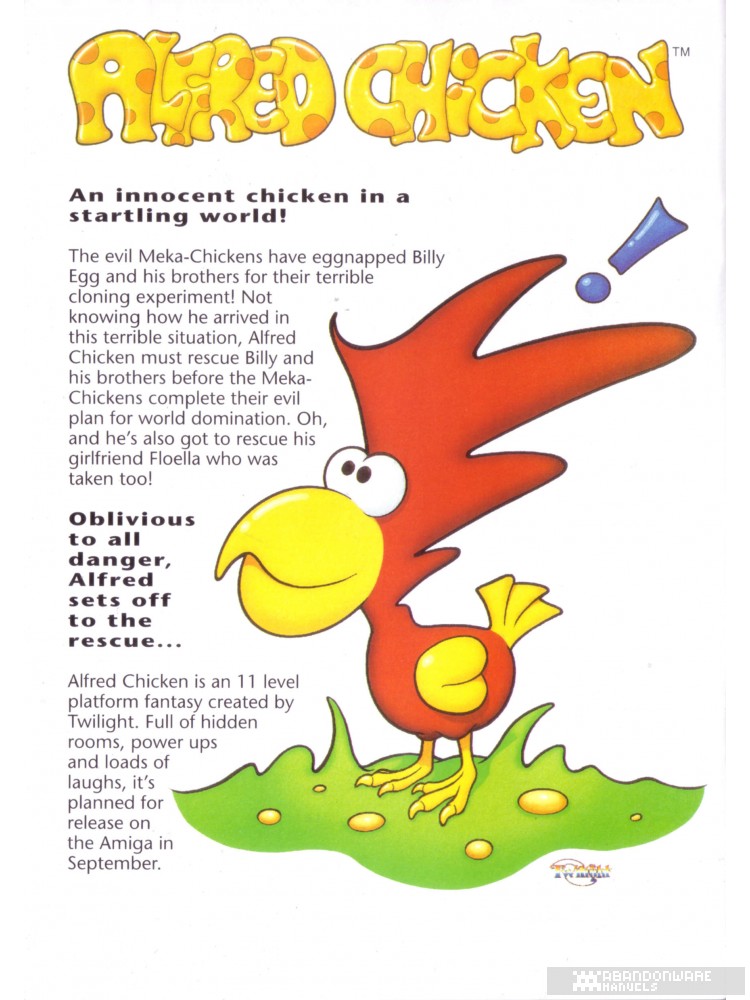
Developed by the British studio Twilight and published by Mindscape, Alfred Chicken was a colorful platform game built around deliberately strange ideas. Alfred had a bionic beak. His enemies included robotic Meka-Chickens. His friends had been kidnapped for a cloning experiment. His worlds were filled with balloons, springs, watering cans, cans of worms, diamonds, cheese, machinery, and other objects that seemed to belong together only because they existed inside Alfred’s peculiar universe.
Yet the strangest part of Alfred Chicken’s history happened outside the game.
During the summer of 1993, Mindscape product manager Karl Fitzhugh became an actual candidate in a British parliamentary by-election as part of a publicity campaign connected to the game. Alfred received only eighteen votes, but the stunt proved memorable enough that the Alfred Chicken Party was still being discussed before a House of Commons committee five years later.
For a game that never became one of the defining franchises of the 1990s, Alfred Chicken left behind an unusually rich historical trail.
Twilight and the Hatching of Alfred Chicken
The origins of Alfred lie with British developer Twilight and programmer and designer Jason McGann. In later conversations with Retro Gamer, McGann remembered an early career shaped by the home computer scene of the 1980s. He learned BASIC, moved into Z80 machine code, experimented with games on the ZX Spectrum, and eventually found employment with Harrogate developer Enigma Variations before becoming part of Twilight.
By late 1992, work was underway on what became Alfred Chicken. The surviving credits demonstrate that it was very much the product of a small British development team. Andrew Swann handled programming on the Amiga edition, Peter Tattersall and Wayne Billingham worked on graphics, and veteran game musicians David Whittaker and Mark Knight contributed music and sound. Mindscape’s Steve Whittle served as software producer, while Karl Fitzhugh, who would later become inseparable from the game’s most unusual marketing story, was its product manager.
Mindscape’s own 1993 catalogue promoted Alfred Chicken as an eleven-level platform game created by Twilight. The publisher’s description already contained the major pieces of Alfred’s world, including the Meka-Chickens, Billy Egg, Floella, hidden rooms, strange power-ups, and a collection of environments intended to separate Alfred from more conventional platform games.
An early version was demonstrated at the European Computer Trade Show in 1993. Decades later, one of the disks used during development resurfaced through programmer Andy Swann. Games That Weren’t documented what is believed to be an ECTS demonstration build, noting differences from the finished game including altered Alfred artwork, a different color palette, and an absence of sound effects.
That surviving build offers something more valuable than retrospective memory. It provides direct evidence of Alfred while he was still being shaped into the character players would eventually meet.
The Meka-Chickens and Alfred’s Bionic Beak
The premise never pretended to be serious. The evil Meka-Chickens had kidnapped Billy Egg and his brothers, along with Alfred’s companion Floella, as part of a cloning scheme. Alfred therefore set out across a collection of bizarre worlds to rescue them.
The game’s manuals leaned heavily into poultry jokes, but beneath the humor was a platform game with several distinctive mechanics. Alfred could jump and move through large scrolling stages, but his most characteristic attack involved throwing himself downward beak-first. Enemies could be defeated by striking them during a dive, while springs could send Alfred into otherwise unreachable portions of a level.
The worlds contained balloons that served important functions in progression, diamonds to collect, hidden passages to discover, and strange power-ups whose logic fit the game’s intentionally absurd tone. A pot of jam could lead to offensive abilities, while a can of worms offered another form of protection or attack. Watering cans, secret rooms, switches, and bonus areas rewarded players who explored rather than simply rushing toward the end.
Contemporary reviewers repeatedly returned to that weirdness. Even critics who believed Alfred Chicken was mechanically a fairly traditional platform game often admitted that Alfred himself did not resemble the typical hero. An Amiga Power review in November 1993 gave the game 70 percent and praised the character’s personality even while arguing that the platforming beneath him was more conventional. Other Amiga publications were considerably more enthusiastic. The One gave it 86 percent, Amiga Computing also awarded 86 percent, and Amiga Force reached 87 percent. Amiga Format, by contrast, scored the game only 62 percent.
That range of scores captures Alfred’s position rather well. Reviewers disagreed about whether the game itself was exceptional, but they rarely had trouble remembering the chicken.
From Game Boy to Amiga and Nintendo
The original Alfred Chicken appeared during 1993 as Twilight and Mindscape brought the character to several machines, including the Nintendo Game Boy, Amiga, and Nintendo Entertainment System. The game’s architecture suited conversion because its basic identity rested on platform exploration, character movement, hidden areas, and Alfred’s dive attack rather than on a single machine-specific technology.
The differences between hardware still mattered. A monochrome handheld Game Boy could not reproduce the visual presentation of an Amiga, while Nintendo’s aging NES had different technical limitations of its own. That created several distinct experiences carrying the same character and premise.
The Game Boy edition is particularly important historically because an early EPROM prototype has survived. The cartridge was later digitized by the Video Game History Foundation and released through Hidden Palace. The prototype contains no music and uses a different title screen, giving researchers another glimpse at Alfred Chicken before release.
Meanwhile, the Amiga became one of the most visible homes for Alfred in the European computer press. The game received reviews across an unusually large collection of magazines during late 1993, including The One, Amiga Power, Amiga Joker, Amiga Magazine, Amiga Action, Amiga Format, Amiga Computing, Amiga Force, Computer + Video Games, and CU Amiga. Lemon Amiga’s surviving index of fifteen period reviews produces an average rating of about 74 percent, suggesting a game that was generally regarded as respectable, sometimes excellent, but rarely revolutionary.
An Amiga CD32 edition followed the original computer version into the new CD-based hardware market. Reviewers noted graphical and audio improvements, including additional colors, CD music, and in some versions improved backgrounds. Amiga Computing gave the CD32 version 90 percent, while other publications produced scores ranging from the mid-60s into the 80s.
Alfred was becoming a multiplatform character.
Then Mindscape decided that ordinary advertising was not enough.
Alfred Chicken Runs for Parliament
In May 1993, Conservative member of Parliament Robert Adley died, creating a vacancy in the Christchurch constituency in Dorset. A by-election was scheduled for July 29.
By-elections sometimes attracted novelty candidates hoping to exploit the sudden concentration of press attention. Christchurch became an especially crowded example. Alongside candidates from the Liberal Democrats, Conservatives and Labour appeared representatives of the Monster Raving Loony Party, the Anti-Federalist League, the Buy the Daily Sport campaign, a campaign calling for England football manager Graham Taylor to be sacked, and numerous other minor candidates.
Into this field stepped Mindscape product manager Karl Fitzhugh.
Fitzhugh stood in connection with the Alfred Chicken promotional campaign, effectively transforming a video game mascot into a parliamentary advertising stunt. The campaign involved the enormous Alfred costume that had already helped attract attention to the game, and Alfred’s political message was never intended to be mistaken for a conventional party platform.
On July 29, voters went to the polls.
Liberal Democrat Diana Maddock won an extraordinary victory with 33,164 votes, defeating Conservative Robert Hayward, who received 16,737. Far down the ballot came Karl Fitzhugh representing Alfred, with eighteen votes.
Eighteen.
It was not even last place. Rainbow Alliance candidate John Walley received sixteen. Alfred Chicken had entered British electoral history by two votes.
As an attempt to win a seat in Parliament, the result was obviously nonexistent. As publicity, it was something else entirely. Gaming magazines remembered it, stories about Alfred repeated it, and the bizarre fact that a commercial video game promotion had appeared in an actual parliamentary election became more historically significant with time.
Five years later, Alfred returned to British politics in a setting that Mindscape could hardly have anticipated.
When Alfred Chicken Reached the House of Commons
On June 23, 1998, the House of Commons Home Affairs Committee was taking evidence about electoral procedure. One concern involved frivolous and commercial candidates, particularly in by-elections and in elections where candidates or organizations might gain access to valuable publicity.
Chris Rennard, then Director of Campaigns and Elections for the Liberal Democrats, pointed directly to Christchurch. He recalled the Buy the Daily Sport Party and “the Alfred Chicken Party” as examples of commercial candidacies, explicitly describing Alfred as promoting a computer game. Rennard argued that reforms to nomination requirements and candidate signatories could make such candidacies more difficult.
A written submission included in the committee’s evidence made the connection equally clear. Discussing proposals for increasing the number of signatures required to nominate a candidate, it cited frivolous or commercial examples including the Buy the Daily Sport Party and the Alfred Chicken Party.
It would be an exaggeration to claim that Alfred Chicken alone changed British election law. He did not. The committee was considering a much wider collection of electoral problems involving misleading candidate descriptions, frivolous campaigns, deposits, nomination papers, and future European elections.
What can be documented is stranger and more interesting anyway. A marketing campaign for a 1993 platform game became part of formal parliamentary evidence concerning how Britain should regulate political candidacies.
Few video game characters can make the same claim.
Super Alfred Chicken
Alfred’s career continued after the 1993 releases. In 1994, Mindscape published Super Alfred Chicken for the Super Nintendo Entertainment System in North America, while the European edition retained the simpler Alfred Chicken title.
The SNES game substantially expanded the adventure to twenty-one levels. The essential premise remained recognizable. The Meka-Chickens had taken Billy Egg, his brothers, and Floella for their cloning plans, leaving Alfred to cross a series of strange dimensional stages while fighting enemies and searching for secrets.
American reception again fell somewhere between affection and indifference. Electronic Gaming Monthly treated the game as slower and more deliberate than many platformers, while the contemporary Nintendo press viewed it as a competent entry in an already crowded genre. The NES edition had the additional problem of reaching North America in 1994, near the end of the commercial life of Nintendo’s original 8-bit system.
Yet Alfred had accomplished something most minor mascot characters never managed. Within a short span, he had appeared on handheld hardware, home computers, 8-bit consoles, 16-bit consoles, and CD hardware.
There were plans for more.
The Alfred Chicken That Sega Never Received
Among the most fascinating pieces of surviving Alfred history is an unreleased Sega Mega Drive version.
A prototype dated July 14, 1994, eventually surfaced and was publicly documented by Hidden Palace. The build identifies Twilight as developer, but unlike the Nintendo and Amiga versions, this edition never reached store shelves. Preservation records state that the Mega Drive project was cancelled after a publisher could not be secured.
The abandoned conversion demonstrates that Twilight still saw possibilities in Alfred after the initial wave of releases. Had another publisher agreed to take the risk, Alfred might have appeared on Sega’s enormously successful 16-bit hardware alongside Sonic and the many other mascot platformers competing for attention.
Instead, the prototype became a historical artifact.
Its survival, together with the ECTS Amiga build, Game Boy prototype, and a surviving SNES prototype, makes Alfred unusually well represented in game preservation circles. Researchers can compare multiple stages of development rather than relying only on finished cartridges and later recollections.
Alfred Returns in the 2000s
Alfred did not disappear permanently when the original Twilight era ended.
In 2000, Möbius Entertainment developed Alfred’s Adventure for the Game Boy Color, with SCi publishing the game in Europe. The project returned Jason McGann to both the character and game design. Surviving credits identify him with game and character design as well as programming, while David Whittaker again supplied music and sound. The Centre for Computing History records the European release in September 2000.
Two years later Alfred made another unlikely comeback, this time on the original Sony PlayStation. The 2002 Alfred Chicken was developed at Möbius by its King Monkey team and published by Sony Computer Entertainment Europe. McGann served as creative director, main programmer, and level designer. The credits even identify the Alfred Chicken copyright with J. P. McGann, showing the continuing connection between the character and his original creator.
The PlayStation game arrived nearly a decade after the red chicken’s original adventure, at a time when three-dimensional games had transformed the industry, and the mascot boom of the early 1990s already seemed like another age.
Alfred still refused to remain buried.
Preserving Alfred Chicken
The history of older video games is often difficult to reconstruct because development materials were discarded, companies disappeared, disks deteriorated, and prototypes remained in private collections. Alfred Chicken has been unusually fortunate.
Andy Swann’s recovered Amiga disk preserved what appears to be the ECTS demonstration. The Video Game History Foundation helped preserve an early Game Boy cartridge. A European SNES prototype survives. The cancelled Mega Drive version eventually emerged as well. Even prototype PlayStation builds from 2001 and 2002 have been documented, showing incomplete menus, different music, missing scenes, debug functions, and other differences from the final release.
At the same time, the print record is remarkably extensive. British Amiga magazines, Nintendo publications, American magazines such as Nintendo Power, Electronic Gaming Monthly, and GamePro, publisher catalogues, instruction manuals, advertisements, and later developer interviews make it possible to follow Alfred from development through marketing and reception.
Then there is the parliamentary record.
That single strange publicity campaign means historians studying Alfred Chicken can consult not only gaming magazines and software archives but the official publications of the British House of Commons.
Why Alfred Chicken Matters
Alfred Chicken was never Mario. He was never Sonic. He did not become the foundation of a global entertainment empire, and his name is unlikely to produce instant recognition among players who did not live through the platform-heavy gaming culture of the early 1990s.
That is precisely why his history is worth preserving.
Games like Alfred Chicken reveal what the industry looked like beyond its handful of permanent superstars. The early 1990s were filled with developers and publishers searching for characters who might become the next recognizable mascot. Some lasted for decades. Others received one or two games before disappearing. Alfred occupied the unusual middle ground. He never became an industry icon, but he survived across enough systems, revisions, prototypes, remakes, and marketing campaigns to leave a substantial record behind.
His story also demonstrates how far publishers were willing to go for attention. Mindscape did not merely purchase magazine advertisements or send promotional merchandise to retailers. Someone connected to its game stood in a genuine parliamentary election.
The campaign earned eighteen votes.
Five years later, members and witnesses before a House of Commons committee were still talking about it.
Today Alfred’s prototypes sit in preservation archives, his original reviews survive in scanned magazines, his games remain artifacts of the British development scene, and his strange parliamentary campaign belongs equally to video game history and political history.
For a chicken whose principal weapon was flying face-first into the ground, that is an impressive legacy.
Sources & Further Reading
Mindscape International. “Alfred Chicken.” In Mindscape International 1993 Product Catalogue. 1993. https://www.abandonware-france.org/abw_images/bibliotheque/hd_mindscape_international_1993_70777.jpg
Mindscape International and Twilight. Alfred Chicken: Game Boy Instruction Manual. 1993. https://gbdbstorage.s3.amazonaws.com/manuals/dmg/DMG-C3-USA_En_0.pdf
Twilight and Mindscape. Alfred Chicken: Amiga Manual. 1993. https://www.lemonamiga.com/doc/alfred-chicken/46
“Alfred Chicken.” Amiga Power, no. 26, June 1993, 23. https://www.abandonware-france.org/bibliotheque/magazines/amiga-power-28/numero-26-4242/
“Alfred Chicken.” Nintendo Magazine System, no. 6, March 1993, 30. https://www.outofprintarchive.com/catalogue/nintendomagazinesystem/NMS6.html
Lowe, Andy. “Alfred Chicken.” GamesMaster, no. 5, May 1993, 82. https://www.retromags.com/files/file/3256-gamesmaster-issue-005-may-1993/
“Alfred Chicken.” Nintendo Game Zone, no. 6, April 1993, 28. https://archive.org/details/nintendo-game-zone-06/page/28/mode/2up
“Alfred Chicken.” GB Action, no. 11, April 1993, 13. https://archive.org/details/gb-action-11/page/13/mode/2up
“Alfred Chicken.” Total!, no. 17, May 1993, 52. https://archive.org/details/total-17-may-1993/page/52/mode/2up
“Alfred Chicken.” Nintendo Magazine System, no. 11, August 1993, 38. https://www.outofprintarchive.com/catalogue/nintendomagazinesystem/NMS11.html
“Alfred Chicken.” Nintendo Game Zone, no. 13, November 1993, 40. https://archive.org/details/nintendo-game-zone-13/page/n39/mode/2up
“Alfred Chicken.” Total!, no. 23, November 1993. https://archive.org/details/total-23/page/n83/mode/2up
Byron, Simon. “Alfred Chicken.” The One, no. 61, October 1993, 66. https://www.lemonamiga.com/game/alfred-chicken
Davies, Jonathan. “Alfred Chicken.” Amiga Power, no. 31, November 1993, 44–45. https://www.amigareviews.leveluphost.com/alfredch.htm
Löwenstein, Richard. “Alfred Chicken.” Amiga Joker, November 1993, 92. https://www.amigareviews.leveluphost.com/alfredch.htm
van Rijn, Lawrence. “Alfred Chicken.” Amiga Magazine, no. 24, November 1993, 75. https://www.lemonamiga.com/game/alfred-chicken
McNally, Steve. “Alfred Chicken.” Amiga Action, no. 51, December 1993, 36. https://archive.org/details/amigaaction51/page/n35/mode/2up
Baguley, Richard. “Game Review: Alfred Chicken.” Amiga Format, no. 53, December 1993, 98. https://www.amigareviews.leveluphost.com/alfredch.htm
Clays, Simon. “Alfred Chicken.” Amiga Computing, no. 68, Christmas 1993, 142. https://www.amigareviews.leveluphost.com/alfredch.htm
Marke, Chris, and Ian Osborne. “Alfred Chicken.” Amiga Force, no. 13, Christmas 1993, 44–45. https://www.lemonamiga.com/game/alfred-chicken
Tipping, Amanda. “Alfred Chicken.” Computer + Video Games, no. 145, December 1993, 40. https://www.lemonamiga.com/game/alfred-chicken
Dillon, Tony. “Alfred Chicken.” CU Amiga, December 1993, 184. https://www.amigareviews.leveluphost.com/alfredch.htm
“Now Playing: Alfred Chicken.” Nintendo Power, no. 57, February 1994, 106. https://archive.org/stream/Nintendo_Power_Issue001-Issue127/Nintendo%20Power%20Issue%20057%20February%201994
“Review Crew: Alfred Chicken.” Electronic Gaming Monthly, no. 56, March 1994, 42. https://archive.org/details/Electronic_Gaming_Monthly_56/page/n41
LaMancha, Manny. “ProReview: Alfred Chicken.” GamePro, no. 58, May 1994, 80. https://archive.org/details/GamePro_Issue_058_May_1994/page/n81
Campbell, Stuart. “Alfred Chicken.” Amiga Power, no. 34, February 1994, 80–81. https://www.amigareviews.leveluphost.com/alfredch.htm
Patterson, Mark. “Alfred Chicken.” CU Amiga, February 1994, 51. https://www.amigareviews.leveluphost.com/alfredch.htm
Maddock, Jonathan. “Alfred Chicken.” Amiga Computing, no. 71, March 1994, 126. https://www.amigareviews.leveluphost.com/alfredch.htm
Wynne, Stuart. “Alfred Chicken.” Amiga CD32 Gamer, no. 1, March 1994, 20. https://magazinesfromthepast.fandom.com/wiki/Alfred_Chicken
“New Games Cross Review: アルフレッドチキン.” Weekly Famicom Tsūshin, no. 345, July 28, 1995, 32. https://www.famitsu.com/games/t/20970/
Famitsu. “アルフレッドチキン.” Famitsu.com. Accessed October 10, 2026. https://www.famitsu.com/games/t/20970/
Games That Weren’t. “Frog Dude Mega Drive and Alfred Chicken Amiga Prototypes Released.” February 2014. https://www.gamesthatwerent.com/2014/02/frog-dude-megadrive-and-alfred-chicken-amiga-prototypes-released/
Hidden Palace. “Alfred Chicken (Prototype).” Accessed October 10, 2026. https://hiddenpalace.org/Alfred_Chicken_%28Prototype%29
Hidden Palace. “Alfred Chicken (Jul 14, 1994 Prototype).” Accessed October 10, 2026. https://hiddenpalace.org/Alfred_Chicken_%28Jul_14%2C_1994_prototype%29
Hidden Palace. “New Years 2022.” 2022. https://hiddenpalace.org/News/New_Years_2022
Boothroyd, David. “Results of Byelections in the 1992–97 Parliament: Christchurch.” Election Demon. Archived July 20, 2017. https://web.archive.org/web/20170720031954/http://www.election.demon.co.uk/by1992.html
“Christchurch By-Election, 29 July 1993.” British Parliamentary By-Elections. Archived August 21, 2009. https://web.archive.org/web/20090821055230/http://www.by-elections.co.uk/christchurch.html
Great Britain. House of Commons. Home Affairs Committee. Appendices to Minutes of Evidence, Electoral Law and Administration. 1998. https://publications.parliament.uk/pa/cm199798/cmselect/cmhaff/768/768ap33.htm
Great Britain. House of Commons. Home Affairs Committee. Minutes of Evidence, Tuesday 23 June 1998. 1998. https://publications.parliament.uk/pa/cm199798/cmselect/cmhaff/768/8062307.htm
Gipp, Stuart. “The Making of: Alfred Chicken.” Retro Gamer, no. 215. https://pocketmags.com/retro-gamer-magazine/issue-215/articles/the-making-of-alfred-chicken
Mansfield, Dylan. “Alfred Chicken: Cheesy Mascot, Eggcellent Politician.” Gaming Alexandria, July 2019. https://www.gamingalexandria.com/wp/2019/07/alfred-chicken-cheesy-mascot-excellent-politician/
Lemon Amiga. “Alfred Chicken.” Accessed October 10, 2026. https://www.lemonamiga.com/game/alfred-chicken
Amiga Reviews. “Alfred Chicken.” Accessed October 10, 2026. https://www.amigareviews.leveluphost.com/alfredch.htm
OpenRetro. “Alfred Chicken.” Accessed October 10, 2026. https://openretro.org/amiga/alfred-chicken
OpenRetro. “Alfred Chicken CD32.” Accessed October 10, 2026. https://openretro.org/cd32/alfred-chicken
MobyGames. “Alfred Chicken.” Accessed October 10, 2026. https://www.mobygames.com/game/12602/alfred-chicken/
MobyGames. “Alfred’s Adventure.” Accessed October 10, 2026. https://www.mobygames.com/game/127580/alfreds-adventure/
MobyGames. “Alfred Chicken Credits, PlayStation.” Accessed October 10, 2026. https://www.mobygames.com/game/21863/alfred-chicken/credits/playstation/